JimYeh

Which Section of the Thermal Path Does a 3D Vapor Chamber Actually Change?

By the time a new cooling structure shows up in a vendor briefing, several numbers in your design are already frozen. Chassis height went into the mechanical envelope months ago. Fan part numbers went into the BOM. The rack power allocation went into a conversation that is not easy to reopen. If a liquid loop […]

Which Section of the Thermal Path Does a 3D Vapor Chamber Actually Change? Read More »
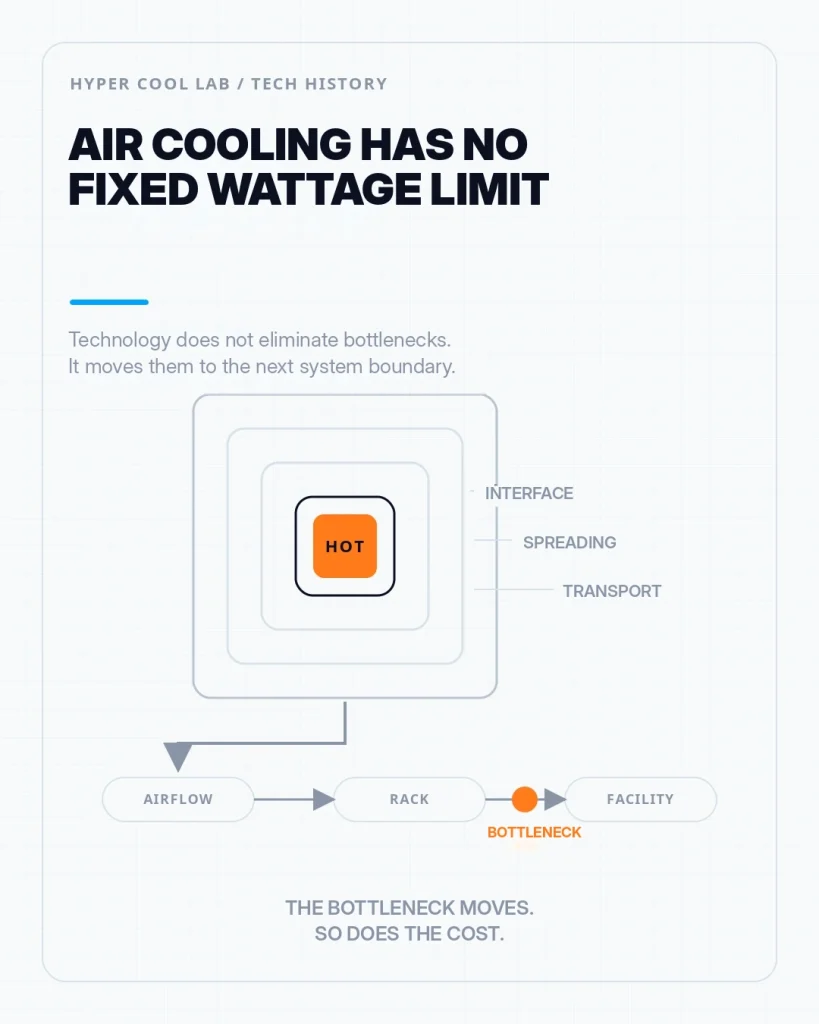
Air cooling limits mapped from package and interface through heat spreading, transport, airflow, rack heat rejection, and facility infrastructure

What Actually Limits Air Cooling? How Heat Pipes, Vapor Chambers, and Direct Liquid Cooling Moved the Boundary

“Air cooling has reached its limit.” Engineers have repeated some version of that sentence for decades. Sometimes it has been directionally correct. It has rarely been complete. The missing question is: Which limit? Is the limit at the package interface? Is heat failing to spread across the cooler base? Has a heat pipe reached its

What Actually Limits Air Cooling? How Heat Pipes, Vapor Chambers, and Direct Liquid Cooling Moved the Boundary Read More »

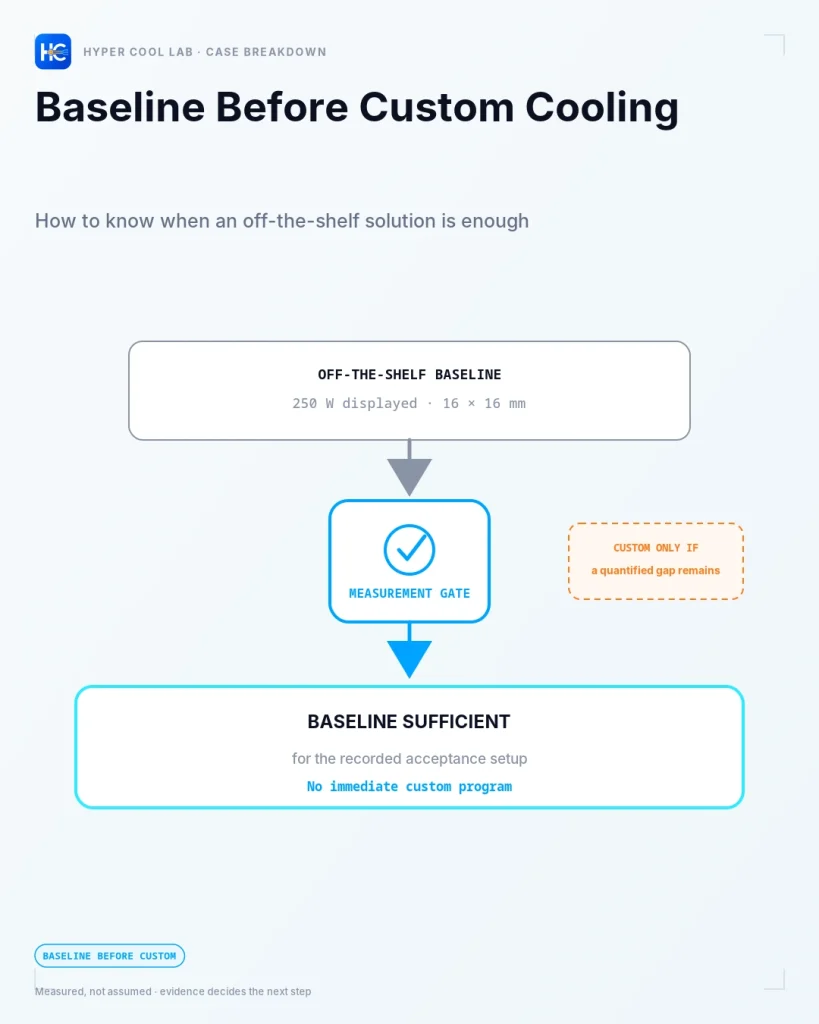
Off-the-shelf cooling baseline evaluated before custom cooling investment

Baseline Before Custom Cooling: How to Know When an Off-the-Shelf Solution Is Enough

A custom cold plate can feel like the most decisive response to a difficult thermal problem. It creates visible progress. A geometry can be designed, machined, assembled, and tested. When a hardware team is approaching a temperature limit—or working inside a tight mechanical envelope—moving directly into custom cooling may seem more productive than spending time

Baseline Before Custom Cooling: How to Know When an Off-the-Shelf Solution Is Enough Read More »

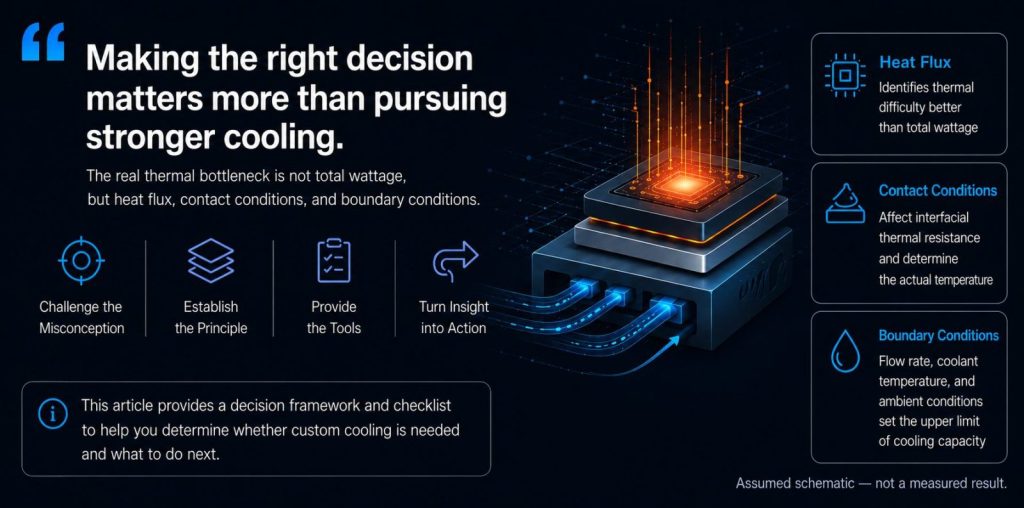
Heat flux discriminates where wattage does not, but it is a signal, not a criterion. A defensible thermal assessment needs six inputs, not one number. Worked example.

High Wattage Is Not the Same as High Thermal Risk: The Six Inputs a Defensible Thermal Assessment Needs

The short version A defensible thermal assessment cannot rest on total wattage alone — it requires power and power distribution, effective heat-source area, TIM and contact conditions, package and thermal path, cooling boundary conditions, and allowable component or interface temperature. Total power is necessary but does not set difficulty. 200 W over 20 cm² is

High Wattage Is Not the Same as High Thermal Risk: The Six Inputs a Defensible Thermal Assessment Needs Read More »